 How to Play Canasta (4 Players, 2 Decks)
 🎯 Objective of the Game
The goal of Canasta is to form melds (sets of three or more cards of the same rank) and make Canastas (seven or more cards of the same rank) to score points. The team with the highest total score after one or more hands wins!
🃎 Setup
- Players: 4 players in 2 teams (partners sit opposite each other).
- Decks: 2 standard 52-card decks + 6 Jokers (total 110 cards).
- Deal: Each player gets 11 cards. The rest form the draw pile.
- The top card of the draw pile is turned over to start the discard pile.
- If the top discard card is a wild card, cover it with another card from the draw pile.
🪑 Table Layout
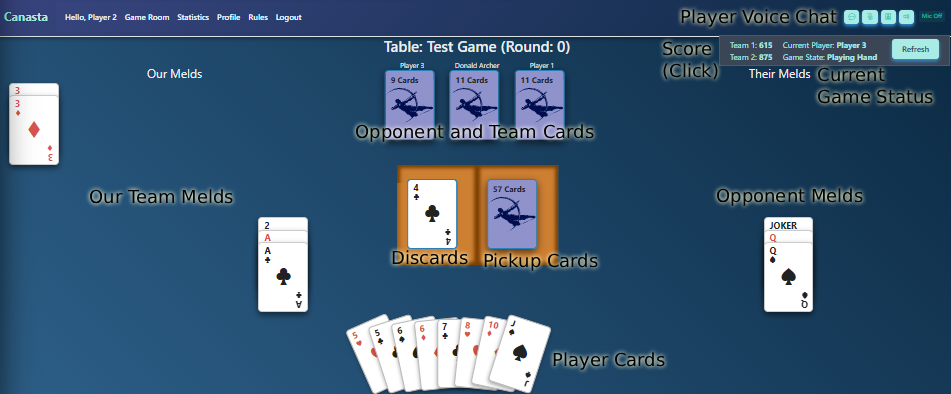
The table has these main areas:
- 🃏 Draw Pile: The deck players draw cards from.
- 🗑️ Discard Pile: The pile where players discard cards at the end of their turn.
- 💥 Meld Areas: Each team’s area for laying down melds and Canastas.
🎮 Gameplay Overview
- Draw a Card: At the start of your turn, draw from the draw pile or take the entire discard pile (only if you can immediately use its top card in a meld).
-
Meld Cards:
- Lay down 3 or more cards of the same rank (e.g., three 8s).
- Your first meld must meet the game’s minimum point value for your team, based on your current score:
- 0–1499: 50 points
- 1500–2999: 90 points
- 3000–5000: 120 points
- You can add more cards to existing team melds later.
- You may not put down melds in the first game, except for red 3s.
-
Special Card: Red 3
- Always place red 3s down immediately.
- They count toward your score at the end of the game.
- They do not count toward the starting meld value.
- If in the discard pile at the start of the game, treat them as wild until picked up.
- When you place a red 3, draw another card (unless it came from a pickup deck).
- If still in your hand when a game ends, they count as negative points.
- If you have red 3s but no melds on the table, they are also negative points.
-
Canasta: When a meld reaches 7 cards, it becomes a Canasta
- Natural Canasta: All natural cards (no wilds).
- Mixed Canasta: Contains up to 3 wild cards (Jokers or 2s).
- Discard: End your turn by discarding one card onto the discard pile.
-
Preventing Discards from Being Picked Up:
- Remember what your opponent on the left discards - this helps guide your own discards.
- If the discard pile is frozen, you can safely discard cards your opponents have melded, as they shouldn’t have those in hand.
- Black 3s and wild cards are always safe to discard.
-
Discard Pile Rules:
- You can pick up the discard pile if you can add the top card to an existing meld.
- You can also pick it up if you have two of the same card in hand (creating a meld).
- You may use one matching card and a wild card if the pile isn’t frozen.
- Discarding a wild card freezes the pile.
- If a black 3 is on top, no one can pick up the pile.
- If frozen and you have no melds, you may not pick up the pile.
🃏 Wild Cards
- Jokers (🃏) and 2s are wild cards.
- They can substitute for any rank in a meld - but no more than 3 wilds per meld.
- Wild cards may not equal or exceed the number of natural cards in the meld.
🚪 Going Out (Ending a game)
A player may “go out” (end the hand) when their team has at least one Canasta and they can play all their cards, with or without a final discard.
The partner must approve before going out unless the player has already played all their cards.
📈 Scoring
After a game ends, teams total their points:
- Natural Canasta: 500 points 🏆
- Mixed Canasta: 300 points 🥈
- Each Card in Melds: Add face values (4–7 = 5 pts, 8–K = 10 pts, A = 20 pts, 2s = 20 pts, Jokers = 50 pts)
- Going Out Bonus: 100 points ✨
- Red 3s: 100 points each (double if all 4 and you have a Canasta; negative if in hand or no melds)
- Subtract the value of cards left in players’ hands.
- Once you reach a new score tier, your required opening meld value does not decrease if your score later drops.
Games are often played to 5000 points.
🧩 Example of Play
If your score is under 1500, your initial meld value is 60 points.
In your first game, you may only play red 3s.
In your second game, suppose you have 5♥, 5♣, 5♦, 2♠ - that’s 35 points, not enough to open.
8♥, 8♣, 2♠, 2♠ is invalid since wild cards can’t equal or exceed the natural cards.
But 8♥, 8♣, 8♦, 2♠ This is 50 points - you can now open your melds.
After this, any additional melds can be placed freely.
Suppose you draw and have 8♥ + 8♦ + 2♠ - you can meld this, as the 2♠ acts as a wild.
Later, your partner adds 8♣ + 8♠ + 8♣ + 2♠ to reach seven total - that’s a Canasta!
🏁 Winning the Game
After multiple games, the first team to reach 5000 points wins. If both teams exceed 5000, the higher total wins.
Strategy, timing, and teamwork are key - know when to hold, when to meld, and when to go out.
Always plan your discard - games are often lost by giving the opponent an easy pickup.
Catching your opponents with big negatives and no melds is always satisfying!